Monday, June 7, 2010

Sanchez Reaches Out to Former MVP Gannon, Talks Decision Making

Uh, talking decision making with Rich Gannon? Do people forget his five interception performance in the 2002 Super Bowl loss to the Tampa Bay Buccaneers that sent his Oakland Raiders into serious tailspin, one that still continues today?

In fact, it seems as though there is no light at the end of the tunnel for Al Davis and his Raiders. As his famous phrase goes, "just win baby, win," well that doesn't seem like it is going to happen anytime soon in Oakland.

I don't know why Mark Sanchez decided to reach out to Gannon of all people. I'm sure there are plenty of other quarterbacks better than him that would be willing to work with the effervescent Sanchez. But, nonetheless, I am glad to see he is reaching out to someone with at least a decent track record and it could be worse. He could be asking Brett Favre about how to take care of the football.

Sanchez is still recovering from offseason knee surgery but hopes to be ready for minicamp in June, but he still wants to stay sharp and work on the mental side of the game with Gannon. Gannon worked with Sanchez for two days recently, studying film at the Jets' complex in Florham Park, N.J.
"The great thing about Mark is he doesn't just want to be good; he wants to be great," Gannon told USA Today. "And he's willing to put in the work to get there.

"He has a very bright future."

Although Sanchez helped the Jets reach the AFC Championship Game in his rookie season, he endured an up-and-down year where he threw an AFC-worst 20 interceptions, was sacked 26 times and fumbled 10 times.

Gannon told the newspaper that he and Sanchez talked about making the right decisions on third down and in the fourth quarter.

"We watched the interception and sack reels until 8 o'clock at night," Gannon told USA Today. "Then he had to get treatment the next morning. I was up at 6 and in at 7 watching the film with him.
"I really applaud a guy like that who wants to get better."

Gannon told the newspaper that he was impressed by Sanchez's progress in his recovery from arthroscopic knee surgery in February.

Sanchez had the patella-stabilizing ligament in his left knee repaired in February, and he has participated in individual and passing drills since organized team activities began last month.

"This kid is back already throwing and is much further along than I thought he would be," Gannon told USA Today. "The goal is to have him back almost 100 percent by June 14 minicamp. He's throwing the ball particularly well, even though he told me he's not 100 percent yet with that knee.

"I don't think it's going to be an issue."

It better not be an issue because the entire Jets season is resting on the health of that left knee.

Case in point: This past Thursday’s OTA at the Jets’ practice facility. Sanchez threw a nice back-shoulder 50-yard bomb that David Clowney caught after a slight adjustment. After Clowney waltzed into the end zone, Sanchez slapped his knee in frustration -- the ball should have been thrown in front of the wide-open receiver, requiring no adjustment at all. Last season, Sanchez might have made that connection perfectly.

But to really understand the progress Sanchez is making, it’s important to go back one play earlier. On a quick wide receiver screen to his right, Sanchez dropped back, planted his feet and seemed to lock his left -- surgically repaired -- leg in the grass. As a result, when the ball was released, it took a nose dive -- incomplete.

Quarterbacks coach Matt Cavanaugh quickly came over to Sanchez and motioned with his throwing arm to keep the release point up to avoid having top spin on the football. The next play, Sanchez did exactly what Cavanaugh instructed and the result was the long touchdown pass to Clowney.

"I’d be lying if I told you I saw that," said head coach Rex Ryan, when asked about Cavanaugh’s subtle instruction to his young QB. "That’s why we have Matt."

Sanchez said it was no big deal. "They're pretty happy with my mechanics," he said. "I’m using my legs. My feet are under me. I’m driving the ball."

Sanchez is still limited. Seven-on-seven drills are no problem. But team drills are still a no-no. In fact, Sanchez sneaked into a team drill last week for one hand-off to a running back, and got reprimanded by Ryan, who got an earful from team owner Woody Johnson.

"Rex said, ‘Next time you do it, make sure Mr. Johnson is not out there,’" said Sanchez, who is attacking these practices with his trademark boyish bounce and grin.

Sanchez said he hopes to be ready for all team activities for a three-day minicamp beginning June 14. But Ryan stressed that Sanchez has not been given clearance by the team’s medical staff.

Despite the additions of some big-name veterans -- LaDanian Tomlinson, Jason Taylor and Antonio Cromartie -- Ryan knows this team will get only so far without a healthy Sanchez. That’s why he’s being careful. But so far he likes what he sees.

"He really knows this offense well," Ryan said. "All that time rehabbing the injury has been a blessing, because he’s been here with the coaches all the time. He looks fantastic. Last year, you saw a lot of positive things, but you also saw a lot of negatives. Right now, he’s throwing the ball great. He’s got such a great grasp of the system and that’s so encouraging to me."

"Now, I’m visualizing it," said Sanchez. "I’m seeing the concept. Audible mechanics. Route depth. Little nuances ... every day it’s feeling better."

Ryan and the rest of the front office is saying that Sanchez will be ready for training camp in July in Cortland, N.Y.

Saturday, June 5, 2010

John Wooden Dies at 99

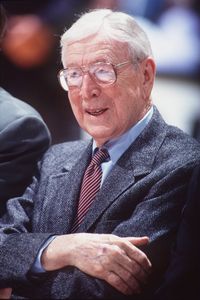
John WoodenJohn Wooden, college basketball's gentlemanly Wizard of Westwood who built one of the greatest dynasties in all of sports at UCLA and became one of the most revered coaches ever, has died. He was 99.

The university said Wooden died Friday night of natural causes at Ronald Reagan UCLA Medical Center, where he had been hospitalized since May 26.

Jim Wooden and Nancy Muehlhausen issued a statement shortly after their father died, saying, "He has been, and always will be, the guiding light for our family.

"The love, guidance and support he has given us will never be forgotten. Our peace of mind at this time is knowing that he has gone to be with our mother, whom he has continued to love and cherish."
They thanked well-wishers for their thoughts and prayers and asked for privacy.

With his signature rolled-up game program in hand, Wooden led the Bruins to 10 NCAA championships, including an unmatched streak of seven in a row from 1967 to 1973.

Over 27 years, he won 620 games, including 88 straight during one historic stretch, and coached many of the game's greatest players such as Bill Walton and Lew Alcindor -- later known as Kareem Abdul-Jabbar.

"It's kind of hard to talk about Coach Wooden simply, because he was a complex man. But he taught in a very simple way. He just used sports as a means to teach us how to apply ourselves to any situation," Abdul-Jabbar said in a statement released through UCLA.

"He set quite an example. He was more like a parent than a coach. He really was a very selfless and giving human being, but he was a disciplinarian. We learned all about those aspects of life that most kids want to skip over. He wouldn't let us do that."

Wooden is the only person to be inducted into the Basketball Hall of Fame as both a player and a coach.

"He was always the boss. He always knew what to say," former UCLA star Jamaal Wilkes told the Associated Press. "Even in the heyday of winning and losing, you could almost discuss anything with him. He always had that composure and wit about him. He could connect with all kind of people and situations and always be in control of himself and seemingly of the situation."

Walton and Wilkes were among former players who visited Wooden in the hospital this week. Wilkes came twice and said Wooden recognized him and that the coach's mind was "sharp as a tack" until the end although his body was "very, very frail."

Wilkes said he recognized what he called "that little glint" in Wooden's pale blue eyes. He was in the room with Wooden's son when Wooden asked to be shaved.

"His son made the comment that when he got shaved he was getting ready to see Nellie," Wilkes said, referring to Wooden's late wife.

During his second visit Wednesday night, Wilkes asked Wooden if he recognized him.

"His glasses fogged up and he had to clean his glasses," Wilkes said. "He looked at me and said, 'I remember you, now go sit down.' "

St. John's coach Steve Lavin followed a similar career path as Wooden, coaching seven years at UCLA after serving as an assistant at Purdue.

"Even though we anticipated this day, the finality still strikes with a force equal to a ton of bricks," Lavin said. "There was the common affinity we shared for Purdue and UCLA and that forged a unique bond. I turned to him for perspective at every critical juncture over the past 20 years. Ninety-nine years of goodness and now he's back with Nell."


Wooden was a groundbreaking trendsetter who demanded his players be in great condition so they could play an up-tempo style not well-known on the West Coast at the time.
But his legacy extended well beyond that.

He was the master of the simple one- or two-sentence homily, instructive little messages best presented in his famous "Pyramid of Success," which remains must-read material, not only for fellow coaches but for anyone in a leadership position in American business.

He taught the team game and had only three hard-and-fast rules -- no profanity, tardiness or criticizing fellow teammates. Layered beneath that seeming simplicity, though, were a slew of life lessons -- primers on everything from how to put on your socks correctly to how to maintain poise: "Not being thrown off stride in how you behave or what you believe because of outside events."

"What you are as a person is far more important that what you are as a basketball player," was one of Wooden's key messages.

"There will never be another John Wooden," UCLA athletic director Dan Guerrero said. "This loss will be felt by individuals from all parts of society. He was not only the greatest coach in the history of any sport but he was an exceptional individual that transcended the sporting world. His enduring legacy as a role model is one we should all strive to emulate."

Wooden began his career as a teacher during the Great Depression and was still teaching others long past retirement. Up until about two years ago, he remained a fixture at UCLA games played on a court named after him and his late wife, Nell, and celebrated his 99th birthday with a book he co-authored on how to live life and raise children.

Asked in a 2008 interview the secret to his long life, Wooden replied: "Not being afraid of death and having peace within yourself. All of life is peaks and valleys. Don't let the peaks get too high and the valleys too low."

Asked what he would like God to say when he arrived at the pearly gates, Wooden replied, "Well done."

Even with his staggering accomplishments, he remained humble and gracious. He said he tried to live by advice from his father: "Be true to yourself, help others, make each day your masterpiece, make friendship a fine art, drink deeply from good books -- especially the Bible, build a shelter against a rainy day, give thanks for your blessings and pray for guidance every day."

While he lived his father's words, many more lived his. Those lucky enough to play for him got it first hand, but there was no shortage of Wooden sayings making the rounds far away from the basketball court.

"Learn as if you were to live forever; live as if you were to die tomorrow," was one.

"Don't give up on your dreams, or your dreams will give up on you," was another.

Born Oct. 14, 1910, near Martinsville, Ind., on a farm that didn't have electricity or indoor plumbing, Wooden's life revolved around sports from the time his father built a baseball diamond among his wheat, corn and alfalfa. Baseball was his favorite sport, but there was also a basketball hoop nailed in a hayloft. Wooden played there countless hours with his brother, Maurice, using any kind of ball they could find.

He led Martinsville High School to the Indiana state basketball championship in 1927 before heading to Purdue, where he was All-America from 1930-32. The Boilermakers were national champions his senior season, and Wooden, nicknamed "the Indiana Rubber Man" for his dives on the hardcourt, was college basketball's player of the year.

But it wasn't until he headed west to Southern California that Wooden really made his mark on the game.

Wooden guided the Bruins to seven consecutive titles from 1967 through 1973 and a record 88-game winning streak in the early 1970s. From the time of his first title following the 1963-64 season through the 10th in 1974-75, Wooden's Bruins were 330-19, including four 30-0 seasons.

"My reaction is sadness yet at this point we have to celebrate maybe the most important guy in the history of the game," Connecticut coach Jim Calhoun told the AP. "There has been no greater influence on college basketball not just about the game but the team.

"He gave so much to basketball and education. In my opinion if he's not as important as Dr. Naismith, he's right next to him."

The bespectacled former high school teacher ended up at UCLA almost by accident. Wooden was awaiting a call from the University of Minnesota for its head coaching job and thought he had been passed over when it didn't come. In the meantime, UCLA called, and he accepted the job in Los Angeles.

Minnesota officials called later that night, saying they couldn't get through earlier because of a snowstorm, and offered him the job. Though Wooden wanted it more than the UCLA job, he told them he already had given UCLA his word and could not break it.
The Bruins were winners right away after Wooden took over as coach at UCLA's campus in Westwood in 1949, although they were overshadowed by Bill Russell and the University of San Francisco, and later Pete Newell's teams at California.

At the time, West Coast teams tended to play a slow, plodding style. Wooden quickly exploited that with his fast-breaking, well-conditioned teams, who wore down opponents with a full-court zone press and forever changed the style of college basketball.

Still, it would be 16 seasons before Wooden won his first NCAA championship with a team featuring Walt Hazzard that went 30-0 in 1964. After that, they began arriving in bunches, with top players such as Alcindor, Walton, Wilkes, Lucius Allen, Gail Goodrich, Marques Johnson, Michael Warren and Sidney Wicks coming to Westwood.

Each of Wooden's players would learn at the first practice how to properly put on socks and sneakers. Each would learn to keep his hair short and face clean-shaven, even though the fashions of the 1960s and '70s dictated otherwise.

And each would learn Wooden's "pyramid of success," a chart he used to both inspire players and sum up his personal code for life. Industriousness and enthusiasm were its cornerstones; faith, patience, loyalty and self-control were some of the building blocks. At the top of the pyramid was competitive greatness.

"Be more concerned with your character than your reputation, because your character is what you really are, while your reputation is merely what others think you are," Wooden would tell them.

Wooden never had to worry about his reputation. He didn't drink or swear or carouse with other coaches on the road, though he did have a penchant for berating referees.

"Dadburn it, you saw him double-dribble down there!" went a typical Wooden complaint to an official. "Goodness gracious sakes alive!"

Wooden would coach 27 years at UCLA, finishing with a record of 620-147. He won 47 NCAA tournament games. His overall mark as a college coach was 885-203, an .813 winning percentage that remains unequaled.

"Many have called Coach Wooden the 'gold standard' of coaches. I believe he was the 'gold standard' of people and carried himself with uncommon grace, dignity and humility," Duke coach Mike Krzyzewski said. "Coach Wooden's name is synonymous with excellence, and deservedly so. He was one of the great leaders -- in any profession -- of his generation."

Wooden's legacy as a coach will always be framed by two streaks -- the seven straight national titles UCLA won beginning in 1967 and the 88-game winning streak that came to an end Jan. 19, 1974, when Notre Dame beat the Bruins 71-70.

After the loss, Wooden refused to allow his players to talk to reporters.

"Only winners talk," he said. A week later, UCLA beat the Irish at home by 19 points.

A little more than a year later, Wooden surprisingly announced his retirement after a 75-74 NCAA semifinal victory over Louisville. He then went out and coached the Bruins for the last time, winning his 10th national title with a 92-85 win over Kentucky.

After that victory, Wooden walked into the interview room at the San Diego Sports Arena to face about 200 reporters, who let their objectivity slip and applauded.

"When I think of a basketball coach the only one I ever thought of was Coach Wooden. He had a great life and helped so many coaches until well in his 90s," Syracuse coach Jim Boeheim told The Associated Press. "Every time I talked to him he would give me some words of advice. He's the best of all time. There will never be another like him, and you can't say that about too many people."

The road to coaching greatness began after Wooden graduated with honors from Purdue and married Nell Riley, his high school sweetheart.

In a 2008 public appearance with Los Angeles Dodgers announcer Vin Scully, in which the men were interviewed in front of an audience, Wooden said he still wrote his late wife -- the only girl he ever dated -- a letter on the 21st of each month. "She's still there to me," he said. "I talk to her every day."

He coached two years at Dayton (Ky.) High School, and his 6-11 losing record the first season was the only one in his 40-year coaching career.

He spent the next nine years coaching basketball, baseball and tennis at South Bend (Ind.) Central High School, where he also taught English.

"I think the teaching profession contributes more to the future of our society than any other single profession," he once said. "I'm glad I was a teacher."

Wooden disliked the Wizard of Westwood nickname, preferring to be called coach.

"I'm no wizard, and I don't like being thought of in that light at all," he said in a 2006 interview with the UCLA History Project. "I think of a wizard as being some sort of magician or something, doing something on the sly or something, and I don't want to be thought of in that way."

Wooden served in the Navy as a physical education instructor during World War II, and continued teaching when he became the basketball coach at Indiana State Teachers College, where he went 47-17 in two seasons.

In his first year at Indiana State, Wooden's team won the Indiana Collegiate Conference title and received an invitation to the NAIB tournament in Kansas City. Wooden, who had a black player on his team, refused the invitation because the NAIB had a policy banning African Americans. The rule was changed the next year, and Wooden led Indiana State to another conference title.

It was then that UCLA called, though Wooden didn't take the job to get rich. He never made more than $35,000 in a season, and early in his career he worked two jobs to make ends meet.

"My first four years at UCLA, I worked in the mornings at a dairy from six to noon then I'd come into UCLA," he told The Associated Press in 1995. "Why did I do it? Because I needed the money. I was a dispatcher of trucks in the San Fernando Valley and was a troubleshooter. After all the trucks made their deliveries and came back, I would call in the next day's orders, sweep out the place and head over the hill to UCLA."

After he enjoyed great success at UCLA, the Los Angeles Lakers reportedly offered Wooden their head coaching job at a salary 10 times what he was making, but he refused.

Nell, Wooden's wife of 53 years, died of cancer in 1985. Besides his son and daughter, Wooden is survived by three grandsons, four granddaughters and 13 great-grandchildren.

Funeral services will be private. A public memorial will be held later, with a reception for former players and coaches. Rest in peace, Coach. You were one of the greatest in any sport.

Jets Sign "The Terminator"

The Jets signed a player Friday, but it wasn't Darrelle Revis. Or Nick Mangold. It was fifth-round pick John Conner, the former Kentucky fullback. Hey, you have to start somewhere.

Conner signed a four-year contract for $1.99 million, according to a league source. The deal includes a $199,000 signing bonus. If he hits various escalators, the contract can increase to $2.7 million.

The Jets chose Conner (5-11, 240) with the 139th overall pick, the pick they acquired from the Seattle Seahawks in the Leon Washington trade. The former Kentucky fullback, nicknamed "The Terminator," will play behind 16-year veteran Tony Richardson this season before presumably taking over as the starter in 2011 and will contribute immediately on special teams.

"It's a fairytale situation," said a person close to Conner.

The Jets still have three unsigned draft picks -- CB Kyle Wilson (first round), G Vlad Ducasse (second) and RB Joe McKnight (fourth).

Yankees Pitching Coach Takes Personal Leave

New York Yankees pitching coach Dave Eiland is taking a personal leave of absence from the team.

"We'll carry on as business as usual," Yankees manager Joe Girardi said. "Just as when you have a player go down, we'll make it work."

Bullpen coach Mike Harkey will be the pitching coach until Eiland returns. Harkey, a former major leaguer, has been a pitching coach in the minors with the Padres. Charlie Wonsowicz, an advance scout and the Yankees' head video coordinator, will serve as the bullpen coach.

Reached in New York, general manager Brian Cashman said he probably will add a coach from the farm system by Tuesday.

"I'll probably do something temporarily," Cashman said.

Cashman would not say or does not know how long Eiland will be absent.

Girardi declined to give any details as to the nature of Eiland's issues.

"That's all I'm going to give you," Girardi said.

Cashman added, "He's going to take the time he needs. That's it. We'll get him back as soon as practical."

Girardi did say there were no problems between Eiland and him. Cashman said the nature of the Eiland's issue was "nobody's business."

Friday, June 4, 2010

The Kid Says See Ya

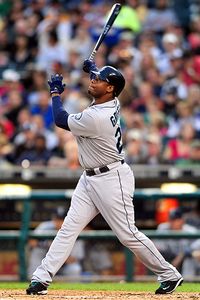
Ken Griffey Jr.In his prime, Ken Griffey Jr. was considered the best player in baseball, on pace to rewrite the record books.

Injuries derailed his chance to become the home run king. His spot as one of the game's all-time greats is without question.

Now relegated to part-time duty and with little pop left in that perfect swing, Griffey unexpectedly decided Wednesday night to retire after 22 mostly brilliant seasons.

The Kid that once saved baseball in the Pacific Northwest with his backward hat, giddy teenage smile and unrivaled talent, had become a shell of the player who dominated the 1990s.

The 40-year-old Griffey wasn't at Safeco Field on Wednesday. He simply released a statement through the Seattle Mariners -- the franchise he helped save in the 1990s and returned to for the conclusion of his career -- that he was done playing.

Griffey said goodbye before Seattle played the Minnesota Twins after 13 All-Star appearances, 630 homers -- fifth on the career list -- and 1,836 RBIs. He's an almost certain first-ballot Hall of Famer.

"While I feel I am still able to make a contribution on the field and nobody in the Mariners front office has asked me to retire, I told the Mariners when I met with them prior to the 2009 season and was invited back that I will never allow myself to become a distraction," Griffey said.

"I feel that without enough occasional starts to be sharper coming off the bench, my continued presence as a player would be an unfair distraction to my teammates and their success as a team is what the ultimate goal should be," he said.

There will be no farewell tour, just as Griffey wanted. He called Mariners team president Chuck Armstrong and said he was done playing. Mariners manager Don Wakamatsu called his players together before the start of batting practice to inform them of Griffey's decision.

"To play with him is a treasure I will keep deep in my heart," Seattle's Ichiro Suzuki said through an interpreter. "I have played 19 years in professional baseball and I can say he was one of my best teammates and my best friend."

Milton Bradley, Griffey's teammate for only a few months, turned to Seattle designated hitter Mike Sweeney during batting practice and said, "on a day like this, it should rain in Seattle."

After Wednesday's 2-1 win over Minnesota, Bradley was emotional speaking about his former teammate.

"I hit left-handed because of Griffey. I wanted to play baseball, be an outfielder, make diving catches, style on a home run because of Griffey," Bradley said. "Guys like him don't come around every day. He's just as magical off the field as on it."

The team put his number 24 in the dirt behind second base and showed a 5-minute video tribute to a standing ovation before the game.

"It's a sad day for the Mariners, our fans, for all the people in the community that have loved Ken, admired him as a tremendous baseball player and a great human being," Mariners CEO Howard Lincoln said. "It's always tough for great superstars like Ken or anyone else to make a decision to retire. This has been his life for so many years, but he has made his decision and will support it. We will honor him in every way possible."

A star from the time he was the overall No. 1 pick in the 1987 draft, Griffey also played with his hometown Cincinnati Reds and the Chicago White Sox. He hit .284 with 1,836 RBIs.
But his greatest seasons, by far, came in Seattle.

Griffey played in 1,685 games with the Mariners and hit .292 with 417 homers, most coming in the homer-friendly Kingdome, and 1,216 RBIs. He won the AL MVP in 1997 and practically saved a franchise that was in danger of relocating when he first came up.
Griffey returned to the Mariners in 2009 and almost single-handedly transformed what had been a fractured, bickering clubhouse with his leadership, energy and constant pranks.

Griffey signed a one-year deal last November for one more season in Seattle after he was carried off the field by his teammates after the final game of 2009. He hit .214 last season with 19 homers as a part-time DH. He was limited by a swollen left knee that required an operation in the offseason.

But the bat never came alive in 2010. Griffey was hitting only .184 with no homers and seven RBIs and recently went a week without playing. There was a report earlier this season -- which Griffey denied -- that he'd fallen asleep in the clubhouse during a game.

The swing that hit as many as 56 homers in a season had lost its punch and Griffey seemed to understand his time was coming to a close.

"Of course it surprised us. You never know what is in a player's mind. They debate things here and there and in this particular case Ken made his decision and there wasn't anything anybody could say," Seattle general manager Jack Zduriencik said. "You support him, you're behind him and again, he's a legacy in this community and certainly in the game of baseball."

His career is littered with highlights, from homering in eight straight games to tie a major league record in 1993, to furiously rounding third and sliding home safe on Edgar Martinez's double to beat the New York Yankees in the AL Division Series in 1995. His first major league at-bat was a double and Griffey homered the first time he stepped to the plate at home.

A year after making his big league debut, Griffey enjoyed one of his greatest highlights. Playing with his All-Star dad, Ken Griffey, they hit back-to-back home runs in a game for the Mariners.

And during the steroids era, his name was never linked to performance-enhancing drugs, a rarity among his contemporaries such as Barry Bonds, Sammy Sosa and Mark McGwire.

"Junior was one of the finest young men I've ever had the opportunity to manage," said Cubs manager Lou Piniella. "When we were in Seattle together, I believe he was the best player in baseball and it was truly an honor to be his manager."

Seattle catcher Rob Johnson watched Griffey in his prime while growing up in Montana. He then got a chance to claim a locker just a few feet away from Griffey's.

"I think it's pretty easy for me to personally say he's the greatest player to ever play this game," Johnson said. "He did everything. He wasn't just a home run hitter. The guy played outfield as good or better than anyone ever played. ... To me he is the greatest player to ever live and to get a chance to play with him and to get to sit next to his locker is pretty special."

Griffey also is regarded as the player who helped keep the Mariners in Seattle, a point Armstrong noted during an impromptu gathering just a few steps from the batter's box at Safeco Field. It was Seattle's unlikely late season playoff run in 1995, spurred by the return of Griffey from injury, that led to the construction of Safeco Field and the future security of a franchise rumored for years to be on the move.

Once he left Seattle for the Reds, injuries began to take their toll and his production started to decline. Griffey's final hit, during his lackluster final season, was fittingly a game-winning pinch-hit single against Toronto on May 20.

"He kept the team here. He drew people here because people wanted to see what he could do day to day," said Seattle first base coach Lee Tinsley, a former teammate of Griffey. "He was such a special player."

There really aren't enough words on this page to describe the impact that Griffey had on the game of baseball. He helped revive it -- along with the homerun race of 1998 -- after the strike of 1994 drove away so many fans.

Griffey was always the consummate professional on and off the field, and even though he loved to be a prankster and kid around, he was always business and was an incredible leader in the clubhouse.

As a friend of mine said, Griffey was the first superstar whose career we followed from beginning to end. And now that it's over, it's like saying goodbye to more than a player -- it's saying goodbye to an era of Seattle history, when grunge was king and we were all going to retire young on our Microsoft stock profits and sales of all those Ken Griffey Jr. Upper Deck rookie cards.

Starbucks may have grown into a world giant during the '90s, but Griffey provided more of an energy boost to Seattle in those days than all of Howard Schultz's caffeine.

"There is going to be a big void that will never be filled," Sweeney said Wednesday. "You can't match Ken Griffey Jr., his charisma on the field, his heart. You can't replace Ken Griffey Jr. on the field or off the field. ... I think Milton Bradley put it best when he said, 'On a day like this, it should rain in Seattle."

And Sweeney played with Griffey for only a little more than a season. Imagine if he really knew what baseball was like here before Junior arrived. Asked what Griffey meant to the team, Armstrong replied, "He was the team."

His final at-bat came as a pinch-hitter Monday night against the Twins with the tying run on base in the ninth. He hit into a fielder's choice and was lifted for a pinch-runner.

That's not the way anyone here wanted it to end. We wanted him to walk up to the plate in the final game of the World Series with everyone from Aberdeen (Kurt Cobain's hometown) to Walla Walla (home of ACME in the Road Runner cartoons) listening to Dave Niehaus call the play-by-play.

We wanted him to swing at a belt-high fastball, showing off that stroke so sweet four out of five dentists recommended you not even look at it. And we wanted the ball to fly, fly away, giving the Mariners the world championship and lifting Seattle higher than any plane Boeing ever designed.

But I guess that just was not meant to be. Griffey is not only one of the greatest players ever to play this game, but he is, in my mind, the greatest player ever to not win a World Series.

Ken Griffey, Jr. was one of my idols growing up and it is so sad to see him gone from this game. See ya at Cooperstown in five years Grif!


Revis Holds Out of OTAs

New York Jets cornerback Darrelle Revis held out of Thursday's offseason training activity because he is unhappy with the progress of talks to rework his contract, according to a league source.

The All-Pro cornerback, 24, was at Florham Park for workouts Wednesday after a five-day break for the Memorial Day holiday, but never arrived Thursday.

He is set to make $1 million in the fourth year of the six-year deal he signed as a rookie, but recently told ESPNNewYork.com that he expects to make more than $15.2 million a year, which is what Oakland cornerback Nnamdi Asomugha makes. Revis wants to be the highest-paid cornerback in the game.

"I think that is fair," Revis told ESPNNewYork.com's Ohm Youngmisuk on May 21. "This is nothing behind closed doors [like] I am fighting against the Jets and they are fighting against me. I have talked to Coach [Rex] Ryan and [general manager Mike] Tannenbaum himself and they believe I should be the highest-paid player at my position. They understand that and I understand that. It is something that is going to get done. The Jets are family to me."

At that time, Revis said the Jets promised him he'd get a new deal before training camp.

"These are not my words," he said. "These are the Jets' words. They promised that it was going to get done before training camp. If it happens, it happens. If it don't, it don't and then there are other situations that have to come upon it."

Ryan said it was too early to draw conclusions about Revis' intentions. "That's part of the business," Ryan said. "We'll see what happens. When it's time to react or get frustrated, I'll react."

Tannenbaum declined to discuss the specifics of Revis' negotiations, but said the Jets were committed to getting a deal done, "within reason." He declined to put a timeline on its completion, however. "Timelines are always tough to estimate," Tannenbaum said.

Revis has a fairly complicated contract in place that would pay him $21 million in guaranteed money during the next three years. Ryan lobbied for Revis to be named NFL defensive player of the year last season, a designation that bolsters the cornerback's case.

Revis is one of several Jets looking to renegotiate their contracts. Offensive lineman Nick Mangold said he and his agent discussed sitting out of OTAs, but decided against it. Mangold said Revis is the team's priority, but others await.

"It should be very interesting to see how it pans out and how they manage it all," Mangold said, adding that he has not ruled out the possibility of holding out during training camp if his own deal is not reworked.

Revis' agent, Neil Schwartz, declined to comment. He is the same agent who represented offensive lineman Pete Kendall and tight end Chris Baker in their contract disputes with the Jets.

Schwartz's clients have not been shy about sitting out of voluntary workouts in the past, but Revis had attended all of the Jets' workouts until Thursday.

"It's a business," offensive lineman Damien Woody said. "Obviously you want everyone here, but there is a business side."

"He'll step right back in and won't miss a beat," linebacker Bart Scott said.

But it is unclear when Revis will return. Although this part of the training schedule is voluntary, the Jets have a mandatory minicamp starting June 14, and players will be fined if they miss a day.

Training camp begins Aug. 1.

Selig Should Overturn Joyce's Mistake and Award Galarraga His Perfect Game

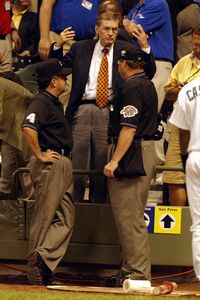
Bud SeligBud Selig can get the shrug back. Right here, right now.

Mulligans aren't normally awarded in sports. Bill Buckner cannot get that Mookie grounder back, Scott Norwood cannot get wide right back, and Greg Norman cannot get a hundred Sunday putts back.

But Bud, this one's for you. Remember that shrug at the 2002 All-Star Game in your very own Milwaukee backyard, where you threw those bony hands in the air, slapped on your best Willy Loman expression, and told the finest baseball players in the world their spirited 11-inning contest would end in a 7-7 tie?

You're getting a do-over, Bud, and here's a little unsolicited advice: Don't shrug this second time around.

Invoke your best-interests-of-the-game powers to make Armando Galarraga and Jim Joyce and Jason Donald and the rest of baseball whole.

The imperfect man pitched the perfect game, Bud, just like the old newspaper story said. The offending umpire, Jim Joyce, is in full agreement even as he picks through the rubble and ash of a distinguished baseball life.


"It was the biggest call of my career," Joyce conceded as he reportedly paced in his dressing room, "and I kicked the [stuff] out of it. I just cost that kid a perfect game."

So this isn't only about granting Detroit's Galarraga his rightful corner of history, or about acknowledging that Galarraga caught Miguel Cabrera's throw and put his foot on the first-base bag before Cleveland's Donald did the same.

This is about freeing Joyce from the grim prison cell that will hold him for the rest of his professional days.

Don Denkinger can fill you in. He once told me on the phone about his infamous blown call that turned the 1985 World Series, when he ruled Kansas City's Jorge Orta safe at first before replays showed that the Cardinals' Todd Worrell had beaten him to the bag.

"It's a crushing feeling," said Denkinger, who received death threats and a never-ending stream of hate mail from gamblers and fans. "You can't imagine what a person feels when you're written about, talked about, and then they show 13 different angles of the call in slow motion."

Life isn't fair, but we like to think of stadiums and arenas as places to go to escape life for a few hours. Games are supposed to be fair. What went down in Comerica Park on Wednesday night was a million miles from fair.

So the expanded use of instant replay is the issue of the day, the item atop the commissioner's morning agenda. Only there's no time to measure the merits of technology against the charms of a sport officiated by fallible men.

That debate isn't going to help Galarraga, or Joyce, or millions of right-minded baseball fans who need some healing ASAP.

Selig shouldn't wait. Even the city of Cleveland would be with him on this one.

He wouldn't be fighting a powerful and antagonistic players union over the issue of performance-enhancing drugs, and he wouldn't be flexing his pecs in an attempt to stop or expedite the sale of a team.

Selig would simply be using his power to call a batter out at first. If the "best interests of baseball" clause doesn't cover that, what the hell does it cover?

"I just watched the replay 20 times," Galarraga said, "and there's no way you can call him safe."

Baseball players, coaches and managers are taught to move on from a moment like this. Get over it. Prepare for the next day's game.

You're supposed to live and die with the good and bad breaks, and remember that the 162-game season is an endless narrative that rewards the characters who weather the most plot twists.

But those terms of engagement just don't cut it here. There's no moving on from the damnation of the 21st perfect game in history, and the third in a month.

This commissioner has always loved to be loved. In fact, I've never met a sports executive who cares more about his or her public standing than Bud Selig.

He wants you to appreciate him for introducing the wild card, for authorizing the Mitchell Report, and for giving birth to the World Baseball Classic. He would also prefer it if you forgot all about that 7-7 score at the 2002 All-Star Game.

Well, here's your big chance, Bud. The Tigers are in the books as 3-0 winners either way.

So grab your heaviest lumber, step into the box, and remember one last thing:

Don't shrug.

Tavares Has Stress Fracture in Foot

New York Islanders forward John Tavares has a stress fracture in his right foot, suffered during a game at the world championships.

Tavares expects to be fine for training camp and says he'll be ready for the season.

He took a shot off the skate during Canada's game against Sweden last month but was able to play the remaining games in the tournament.

When Tavares returned home, an MRI exam revealed the stress fracture.

He appeared at an NHLPA event Thursday wearing a walking cast and says he'll be limited in his workouts for the next couple of weeks.

If this were two weeks before the start of the season I would be worried, but the draft hasn't even happened yet so let's all just relax here.

Thursday, June 3, 2010

Jeter's Next Contract Negotiation Could Hinge on Position Change

The conversation is almost inevitable. The Yankees will ask Derek Jeter his thoughts about changing positions. It really isn't a question of if it will one day take place, it is more when does this conversation happen, and how do you broach the subject with the most legendary Yankee since Mickey Mantle.

That means "The Conversation" could happen as soon as this offseason, when the soon-to-be 36-year-old Jeter's 10-year, $189 million contract expires.

"You have to have a conversation about a transition at some point," said former Mets GM Jim Duquette, who faced a similar circumstance with Mike Piazza's transition from catcher to first base in 2003. "You have to ask, 'When he is comfortable with that?'"

So, as defensive metrics are showing a steep and increasingly rapid decline in Jeter's glove skills, we aren't alone in wondering when, if ever, Jeter will be willing to move from shortstop? When a reporter brought up the topic of a position switch before a game last week in Minnesota, Jeter didn't want to talk much about it.

Reporter: Have you ever thought about playing another position?

Jeter: "Why would I?"

Reporter: Well, Ernie Banks, Robin Yount, Cal Ripken Jr. all switched from shortstop.

Jeter: "I'm not thinking about that."

Then, politely enough, Jeter asked for the interview to end if moving positions was going to be the line of questioning.

The issue is the strongest dynamic at play in this, Jeter's walk year. It is almost impossible to imagine Jeter leaving the Yankees, but it is not implausible to envision him at another position, even if he says it hasn't crossed his mind.

The real questions for Jeter's upcoming negotiations are the amount of years he will get and the position he will play by the contract's expiration date. Will Jeter demand to have the length that Alex Rodriguez's contract has? A-Rod's deal takes him until he is 42.

One prominent agent thinks Jeter and the Yankees will likely come to a four-year, $20 million-plus per season agreement. That would keep Jeter as a Yankee until he is 40. Others feel the sides could work out some personal service contract that could make Jeter a Yankees employee for life.

The Yankees have no vacancies at first, second and third. The outfield could be an option, but if they sign Carl Crawford this offseason, it eliminates left. With Curtis Granderson or Brett Gardner, center may not be available. Maybe Jeter simply DHs more, while continuing to be the No. 1 shortstop? Sure, that's a possibility, but recent stories and rumblings have harped on Jeter's range. The sabermetricians are out there, taunting Jeter with their numbers.

The statistics say Jeter is still going to his right fine, but in the early part of the season, he was having more trouble going to his left.

Remember the recent Sunday night Mets game, in which two balls to his left rolled under his glove? Those helped lower his plus-minus rating, according to Baseball Info Solutions (which looks at how often balls in play are turned into outs), to minus-7 on balls hit to the left of the typical shortstop's spot.

He's since improved that to minus-3, a slight drop from last season. Going left has been an issue for Jeter before -- one he's improved upon greatly after posting ratings of minus-25, minus-10 and minus-14 from 2005 to 2007. The early struggles this year again raised questions.

Scouts have seen it, too, but aren't as alarmed.

"He may not have the range he once had," said an National League advance scout. "He has very long arms that help his range that sometimes goes unnoticed. I don't know why people malign his defense."

The "How is Jeter's defense?" topic is so hot that Yankees general manager Brian Cashman won't even touch it.

"It turns out to be a no-win situation," Cashman said.

Cashman is right. Publicly, it serves the Yankees no value to rev up the debate. Privately, they need to have that talk with Jeter, if they feel he won't always be a shortstop.

"You owe it to a player to tell them what you see," said Mike Arbuckle, a Royals executive who has been in the game for three decades.

But Jeter is not just any player. He is the team's most popular player. He is The Captain. He is a future Hall of Famer with no stains on his reputation, despite playing in the steroid era. He is going to end up in Monument Park.

While the number crunchers say Jeter -- with more age -- will become a statue long before he has a monument, he's possibly the most respected player in the game. How he goes about his work and when he does it the best enters into The Conversation.

"You can't get the perfect player the whole time," an advance scout said. "He is the heart and soul of that team."

Cashman has had a conversation with Jeter about his defense before. Cashman challenged Jeter to improve his range. After enlisting trainer Jason Riley to make Jeter quicker to his left, the question of Jeter's defense had faded following a bounce-back 2009.

Still -- regardless of Cashman's and the Yankees' true feelings about Jeter's defense, if you are going to pay a player $20 million a year, doesn't a franchise have a right to protect itself? Doesn't it need, in the best interest of the organization, to have a plan in place in case Jeter -- at 38, 39 or 40 -- isn't the same defender down the road?

It is possible that Cashman has already broached the topic with Jeter, though there is no evidence of that. One thing that Cashman, like Jeter, doesn't want to have is a conversation about The Conversation.

"That is not a productive conversation to have with you or the public," Cashman said. "There is nothing beneficial."

Cashman added, "We intend to try and re-sign him back this offseason."

In 2003, when Duquette was the GM of the Mets, the team's front office wanted then-manager Art Howe to establish a relationship with Piazza. After meeting about it in the offseason, they decided that spring training would not be the right time for Piazza to work at first, because they felt it would cut into his preparation as a catcher.

During the season, however, in a situation baked with Mets controversy, and after years of the "Piazza to first" debate, Howe casually walked over to Piazza in the dugout and simply said, "We'd like you to take some ground balls at first."

It seemed inevitable that Piazza would be asked to make the move. When Piazza was finally approached about it, he was prepared.

"Mike was great," said Duquette, who now hosts a talk show on XM Radio. "He didn't complain. He didn't balk."

The experiment to move Piazza -- who never said a cross word, but also never looked thrilled -- to first was a disaster. Piazza perhaps knew that his physical tools were not made for the infield. He was awkward at first and his distinguished Mets career ended somewhat clumsily.

The thing about great athletes, Duquette said, is what makes them excel also makes them the last to know. They have always been the best, and their expectations go unchanged even as their career expiration date approaches.

Jeter has always been a shortstop. The idea of running out to another position is as foreign a concept as asking him to settle for a B-level starlet.

"The disagreement always comes about the timing of the move," Duquette said. "I think it is part of the conversation when you are doing the contract."

Maybe they only lightly touch upon it, because there are some in the Yankees universe who think that Jeter may beat Father Time, despite the latter's undefeated record. Jeter, they will say, has a pretty good lifetime record on the diamond.


First, Jeter hit a go-ahead solo home run in the top half of the sixth inning. In the bottom half, there were men in scoring position and two out in a one-run game. The Twins' Delmon Young hit a hard grounder in the hole.

Jeter ranged to his right, backhanded the ball on the edge of the outfield grass and in his signature defensive move, jumped up and made a throw across the diamond to nail Young and save two runs and -- as it turned out -- the game.

It was as if Jeter were incredulously saying, "Have I thought about playing another position? Why would I?"

With Jeter moving into his late 30s, is it too soon to talk about the Yankees' shortstop of the future? The team's top shortstop prospect is also the most ready.

Currently at Triple-A, 22-year-old Dominican Eduardo Nunez has reclaimed his prospect status with a pair of good seasons at the upper levels, but while he can hit, he offers little in terms of power or on-base skills, leaving many to see him as good, but certainly not good enough to play every day for the Yankees.

Beyond that there is little to talk about, as Double-A shortstop Luis Nunez (no relation; Luis is Venezuelan) does little with the bat, while the two A-ball players at the position, Venezuelan Jose Pirela and Dominican Kelvin Castro, both offer defensive abilities but are near zeroes at the plate.

Jeter will likely play shortstop in New York as long as he wants to, but the player who eventually will take his place in the Bronx is probably not a current member of the organization.

But let's get back to the little tidbit I mentioned before about a similar situation a few years back with Piazza and the Mets. Let's start out by saying this: Piazza was never even good behind the plate. He is known for his hitting, not his defense.

Everyone knew that Piazza was not going to be able to smoothly make the transition to first base because he didn't have the hands, footwork or athleticism to do so, let alone not having those skills to catch.

But Jeter and Piazza are totally different figures. Jeter is a god with the Yankees and with baseball, Piazza is not. Jeter is a much better player than Piazza was and this is a totally different situation because Jeter is actually pretty good at shortstop and has won four gold glove awards, compared to the zero that Piazza won.

So let's stop with the comparisons of the situations between Piazza and Jeter because when it's all said and done, Jeter may be the greatest Yankee of all-time, Piazza isn't the greatest Met of all time.

And let's remember to thank Mark Teixeira for slowing the debate of Jeter's defense because Tex saves so many errors for the rest of the infield with his sensational defense; he may be the best first baseman in the game. Jeter also has improved his range thanks to his hard work in the offseason, constantly working with Riley to make himself quicker to his left, as well as staying quick to his right.

So let's quell this debate until the end of the season because right now, there's nothing wrong with his defense; he only has three errors so far.

Posada Comes off DL, Might DH More Often

Yankees catcher Jorge Posada came off the disabled list and started at designated hitter on Wednesday night.

He went 1-for-3 with a single, a walk and scored a run in the Yankees' 9-1 win over the Orioles.

Posada thinks he might DH more than he has in the past, but he is not mentally prepared for it, saying, "I'm not a DH yet."

"I'm going to try to be ready for both," Posada, who had a hairline fracture of his right foot, said of catching and DH'ing.

Francisco Cervelli was behind the plate Wednesday.

"You are probably going to see that lineup a little bit more," Posada said.

When Posada spoke about Cervelli, he made sure to call him "the catcher of the future." Posada definitely still thinks of himself as the catcher of the present.

Juan Miranda was sent down to make room for Posada. Chad Moeller remains as the third catcher, giving manager Joe Girardi the flexibility to DH Posada more.

Tuesday, June 1, 2010

Isles Sign David Ullstrom

Last year with HV71 of the Swedish Elite League, the 6-3, 200-pound Ullstrom was 5-11-16 in 47 games. He was the Islanders’ fourth round pick in the 2008 draft.

Ullstrom, who signed a three-year Entry Level deal, told Point Blank last summer that he was determined to begin his North American playing career in 2010. Most scouts project him as a third-line forward, with an outside chance of developing into a second-liner.

Jankowski Turns Down GM Offer with WHL Team

Contrary to a report that Ryan Jankowski was in the mix to become general manager of the WHL team, a source with the Regina Pats tells Point Blank that the Islanders’ assistant GM politely rejected an overture from the club.

“We reached out to Ryan,” said the source, “but what we heard back was that he was under contract to the Islanders and committed to stay with them for a long time. Despite what was written in some of the papers, he never even came in for an interview.”

The Pats hired Chad Lang yesterday as general manager.

Jankowski is the well-regarded assistant general manager/Director of Amateur Scouting for the Islanders. He spent last week managing the team’s efforts at the NHL Scouting Comine in Toronto in preparation for the draft next month. Among his recent draft picks with promise are Travis Hamonic, Kevin Poulin, Kirill Petrov, Matt Donovan, David Ullstrom, Calvin de Haan and Mikko Koskinen.

Jankowski’s rumored move to Regina was a topic of discussion this week at the Stanley Cup Final, which is why this blog reached out to Regina for clarification. Good to see reports are invented in the Western Hockey League, just as they are in the good old NHL.

It's a good thing that Jankowski decided to stay because he is highly regarded around the NHL and is viewed as an extremely intelligent man with a bright future as an NHL GM. The Islanders will need him for when they let Garth Snow go, which is only hope on my part. That might be soon if the Islanders don't make the playoffs next year. However, seeing as how Mike Milbury remained in power for ten seasons, I don't see Snow leaving anytime soon.