Monday, July 19, 2010

Pettitte Leaves In Third With Groin Strain, Out 4-5 Weeks

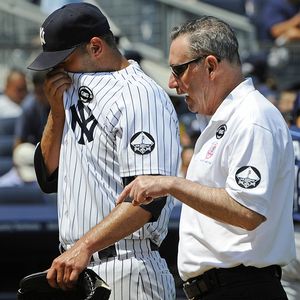
Andy Pettitte, Gene MonahanNew York Yankees left-hander Andy Pettitte is expected to miss four to five weeks with a Grade 1 left groin strain suffered in the third inning of Sunday's 9-5 victory over the Tampa Bay Rays.

Right-hander Sergio Mitre, who has been on the disabled list since June 15 and has not pitched since June 4, will start in Pettitte's place against the Kansas City Royals on Saturday.

Pettitte said he first felt pain after throwing a 2-1 slider to Kelly Shoppach. Manager Joe Girardi and trainer Gene Monahan went to the mound, and Pettitte threw one warmup pitch to catcher Jorge Posada as Girardi and Monahan looked on. The pitcher said he felt significant pain in his left groin during the follow-though of his delivery, and was replaced by reliever David Robertson.

"I've pitched through a lot of stuff, but there was no way. No way,'' said Pettitte, who at 38 is off to one of the best starts of his 16-year career. "Normally, I can pitch through anything but I was hurting pretty bad.''

Pettitte was taken to New York Presbyterian Hospital for an MRI, which revealed the Grade 1 strain, the mildest form of the injury. Considering Pettitte's age and history -- he suffered the same injury in 2001, missing 15 days -- the Yankees expect his recovery to take at least a month.

Pettitte said he can't remember the 2001 injury well enough to estimate the severity of Sunday's ailment. Pettitte pitches with a particularly long stride, and he said that, given his mechanics and his age, he would treat this injury with caution.

"I stride way out and I have to make sure it's right," Pettitte said. "It's definitely something you want to be careful with. ... I'm not gonna try to rush it back. I'm going to try to get well."

In the meantime, Girardi said: "Someone is going to have to step up and take his turn.''


"We're going to roll Mitre out there on Saturday,'' said Yankees general manager Brian Cashman. "He's been rehabbing well and he was a finalist for our fifth starter spot this spring.''

Pettitte's injury came one day after New York starter A.J. Burnett lasted only two-plus innings in a 10-5 loss, leaving the game with cuts on both hands following an angry fit in the clubhouse.

Frustrated by his ineffective outing, Burnett slammed open a set of double doors during the second inning Saturday, slicing both palms on the plastic lineup-card holders fastened to the entry. A day later, he said he apologized to his teammates for the outburst and will make his next scheduled start.

This leaves the Yankees in a big whole. Pettitte has been the most consistent and best starter all season long and to miss him for four to five weeks will be a big loss for them. Don't look for Cashman to trade for a piece though. Sergio Mitre looks like he will get his chance to fill in for Pettitte until he comes back.

This injury couldn't have come at a more inopportune time, as Pettitte was coming off the best first half of his career. Unfortunately for him he will have to wait to really begin his second half of the season, one which he has been very good in throughout his great career.

Saturday, July 17, 2010

Yankees Place Marte on DL, Recall Boone Logan from Scranton

The New York Yankees placed left-hander Damaso Marte on the disabled list and recalled lefty Boone Logan from Triple-A Scranton/Wilkes-Barre to replace him.

Marte has appeared in 30 games mainly as a lefty specialist in middle relief, pitching 17 2/3 innings with a 4.08 ERA and 12 strikeouts. Logan has pitched 18 1/3 innings for the Yankees, with a 3.93 ERA, 12 walks and 13 K's. He will fill Marte's role as the only left-hander in the Yankees' bullpen.

Yanks Play Rays on Boss' Funeral Day

Sheer emotion might help lead the New York Yankees to a winning series as they continue to mourn the passing of owner George Steinbrenner.

The same day the Steinbrenner family is scheduled to hold a private funeral for the longtime owner in Florida, the Yankees try for a third straight victory Saturday against the visiting Tampa Bay Rays.

A few hours after a pregame ceremony honored Steinbrenner, who died of a heart attack at age 80 on Tuesday, the AL East-leading Yankees (57-32) opened up a three-game lead over Tampa Bay by rallying for a 5-4 win Friday.

"(Steinbrenner) wanted to win every game," catcher Jorge Posada said. "162-0 he wanted us to do."

Nick Swisher hit a tying home run in the eighth, then singled home the winning run in the ninth as the Yankees won for the ninth time in 10 games.

"It's just one of those moments, another one of those special moments here at Yankee Stadium," shortstop Derek Jeter said. "It seems like every time you come here there's an opportunity to see something special."

While Steinbrenner's funeral will be held Saturday in Tampa, Fla., more ceremonies will take place during Old-Timers Day at Yankee Stadium.

Playing their first series in 37 1/2 years without their blustery owner, the Yankees have a chance to further distance themselves from the second-place Rays (54-35). The teams have split six games against each other in 2010, and have 12 remaining.

Swisher went 3 for 5 with three RBIs on Friday. The All-Star is 11 for 25 with three home runs in his last six games and 7 for 19 with two homers against the Rays this season.

The Yankees turn to A.J. Burnett (7-7, 4.75 ERA) as he tries for a third straight strong start.Burnett has allowed two runs in 13 2/3 innings over his last two outings. Both runs came in seven innings of a 6-2 win at Oakland on July 7. It was Burnett's first victory since May 30.

"It always starts upstairs," Burnett said of being mentally tough while going 0-5 in his previous six starts. "Not letting the little things bother you, other than what you can control. It's just a matter of staying even keel out there."

The right-hander is 12-5 with a 2.98 ERA in 23 starts against Tampa Bay. However, he allowed six runs in 6 2/3 innings of a 10-6 home loss to the Rays on May 19.

Evan Longoria is 11 for 30 against Burnett. The Tampa Bay All-Star went 1 for 4 with an RBI on Friday. Carl Crawford, who had two hits in the opener, is a lifetime .340 hitter versus Burnett.

Tampa Bay's Jeff Niemann (7-3, 2.77) comes out of the break to face New York for the first time this season. He is 1-0 with a 2.93 ERA in three starts against the Yankees.The right-hander left Sunday's 6-5, 10-inning win over Cleveland after five innings because of back stiffness. Niemann, who allowed three runs, did not seem too concerned with the injury."

A little bit of tightness," Niemann said. "It really wasn't anything big and it shouldn't affect the second half."

Despite Friday's loss, the Rays have won 10 of 13.

Berra Suffers Fall, Will Miss Old-Timers' Day Game

New York Yankees Hall of Famer Yogi Berra will not attend Saturday's Old-Timers' Day at Yankee Stadium after suffering a fall Friday evening at his home in Montclair, N.J.


Berra tripped on his front steps and was brought to nearby Mountainside Hospital, according to Kaplan.

"His nose is pretty banged up," Kaplan said.

Berra was X-rayed and released.

"He's very disappointed as you can imagine," Kaplan said. "He looks forward to this day. And he's sorry he can't be there."

As the Yankees worked on re-writing the script for the day's events, Berra's family released the following statement:

"Yogi fell down last night near our house [in Montclair], and suffered some bruises," the statement said. "He is now recovering at home. He is extremely disappointed he is unable to participate in today's Old-Timers ceremonies and see so many of his friends. He appreciates all the well-wishes and hopes to be up and about very soon."

New York Yankees Will Stay in Steinbrenner Family Forever, Consultant Says

The Steinbrenners are going to be the Yankees' bosses for a very, very long time.

On Wednesday, Marc Ganis, a sports business consultant who has worked with the Yankees for nearly a decade, said that the team will not be sold "basically forever."

"That I can tell you with knowledge of the situation," Ganis told ESPNNewYork.com. "They won't sell. This team is going to stay in the Steinbrenner family. It is both because they desire it and it has been set up this way. This team is going to stay in the Steinbrenner family for a very long time."

Ganis, the president of SportsCorp Limited, had been friends with George Steinbrenner for 15 years and consulted the Yankees on a number of projects.

There has been speculation that the Steinbrenners could sell following the death of their father. Hal and Hank Steinbrenner had been reluctant to be involved with the Yankees until three years ago. Before that, it appeared that Steve Swindal, then Steinbrenner's son-in-law, would take control of the team upon George's passing.

After Swindal and George's daughter, Jennifer, were divorced, Hal and Hank took charge of the team. Now, Hal is the one who is most in charge.

"It is not just George's wishes, but it is also the wishes of the family," Ganis said of keeping the team. "I have gotten to know George's children over the years and they know this is a part of their lives basically forever -- and they want it to be."

Ganis said the Yankees are worth roughly $1.6 billion, and the team owns 40 percent of the YES Network. Ganis valued the Yankees' YES stake at about $1.2 billion, going on the assumption that YES is worth $3 billion in total.

Ganis thinks the ethos of the company was driven by the Boss, whose passing will somewhat change the dynamic of the organization.

"What will be missing is the mythic figure of the guy who will keep everyone in line," Ganis said. "The guy who, if he hears is something is awry, will step in and take everyone to the woodshed in a big way."

Ganis thinks that the way the organization has been set up the last few years, when George faded into the background, is a precursor to the Yankees' continuing their financial might that translates to the field.

"Hal is quieter than George was," Ganis said. "I've seen it personally. He definitely has his father's strength -- even if he exerts in a more quiet way."

Steinbrenner's Legacy Bigger than The Babe's

SteinbrennerGeorge Steinbrenner picked up the phone, and it was good to hear the sound of his voice. Not many people have ever made that claim -- happy to hear from Steinbrenner, that is -- but this would be the last roar from the loudest lion.

The last night The Boss was really The Boss.

He was in declining health in the fall of 2007, and his team was in a declining state in the American League Division Series. Steinbrenner hated losing to his hometown team, the Cleveland Indians, so a call was placed to his suite at the Regency to see if the owner of the New York Yankees could summon one final blast from his past.

"His job is on the line," Steinbrenner said of Joe Torre. "I think we're paying him a lot of money. He's the highest-paid manager in baseball, so I don't think we'd take him back if we don't win this series."

Steinbrenner ripped the umpires that night for allowing a biblical plague of Game 2 bugs to descend on Joba and Jeter and the rest, and he all but pledged to re-sign Alex Rodriguez. But more than anything, amid a wave of reports that he no longer had the capacity to run the world's most famous team, Steinbrenner wanted to make something perfectly clear:

"I have full control," he said.

Born on the Fourth of July, dead nine days after his 80th birthday, George Steinbrenner controlled his team like no owner in the history of American sports. He was the shipbuilder who became bigger than the ship. He was the Yankee who became bigger than the Mick and the Clipper and the Babe.

That's his legacy: A rich kid from Cleveland -- desperate to win the approval of a cold and distant father, desperate to be a titan in the most iconic city -- ended up larger in life than the sluggers who defined Yankees mythology.

Steinbrenner didn't need "Seinfeld" to become America's boss. He was already famous for demanding perfection in others despite his own outlandish imperfections, for berating and terminating employees faster than he could apologize and hire them back.

He was a living, breathing dichotomy -- an owner who could bask in Bucky Dent's indelible home run in Fenway Park in 1978, and then be sure to fire Dent at Fenway a dozen years later. Steinbrenner could gracelessly nudge Don Mattingly toward retirement, but console him at his Kingdome locker after Mattingly lost the one and only playoff series of his career.

In 1996, Steinbrenner could celebrate his first championship in 18 years, and then obliterate a staff member minutes before the Canyon of Heroes parade for allowing the players' wives to ride on the players' floats.

Steinbrenner won seven World Series titles and established himself as the founding father of free agency. He spent billions in pursuit of athletic glory, and got himself suspended for giving money to a United States President (illegal campaign contributions to Richard Nixon) and to a two-bit gambler (digging-up-dirt contributions to Howie Spira).

There's a reason why there was nothing more limited than being The Boss' limited partner.

"George Steinbrenner is the Yankees," his general manager, Brian Cashman, once said. "It's impossible to imagine this team without George Steinbrenner owning it."

The Boss nearly cashed out in talks with Cablevision in 1998, and walked away from the deal when he realized nobody sells the franchise he called the Mona Lisa, certainly not George Steinbrenner.


"From a company standpoint, the city was ours," Cashman said.

"The Boss told me, 'You'd better win or else.' I felt like if we lost to the Mets, it would've diminished our three championships. It would've been like they didn't count. I was always proud of what we'd done, and I'd never before been scared of losing. But I was scared of losing to the Mets."

Steinbrenner thrived on fear. As a former assistant football coach in the Big Ten, he was on a constant search for tackling dummies and a reason to create a fourth-and-1 cloud of dust.

On June 15, 2005, it first became clear Steinbrenner was approaching his final goal-line stand. At a news conference called to unveil the plans for a new Yankee Stadium, someone asked The Boss if the new park would offer Rodriguez a friendly left-field target.

"A-Rod doesn't need any help," Steinbrenner said, "but I don't think the Yankees did right by Babe Ruth when he was here. They should've been better to him. We'll be better to A-Rod when he gets ready to retire."

Reporters and Yankees officials shot each other the oddest of looks. When the news conference ended, one team official whispered, "He's not what he used to be, is he?"

Slowly, surely, Steinbrenner faded from public view as the vile forces of nature and age conspired against him. He'd chased everyone from Catfish Hunter to Roger Clemens, even pumping iron with Clemens on a visit to the Rocket's home.

All of that free-agent recruiting, all of that bickering with Billy and Reggie, all of that back-and-forth with Yogi -- the sights and sounds make for a fascinating portrait of a complicated life.

George Steinbrenner touched them all before dying Tuesday morning with a singular legacy.

Without ever stepping to the plate, the Boss became bigger than the Babe.

Yankees Remember The Boss and Sheppard

Mariano RiveraFrom a stirring pregame ceremony to the impromptu memorial outside of Gate 4, George Steinbrenner's presence could be felt all over Yankee Stadium on Friday night.

The New York Yankees held a four-minute video tribute to Steinbrenner before they played the Tampa Bay Rays -- the first Yankees game since Steinbrenner died on Tuesday.

The ceremony opened with a recording from public address man Bob Sheppard, who died on Sunday, bellowing his trademark greeting to fans at the Stadium: "Good evening, ladies and gentleman, and welcome to Yankee Stadium."

Steinbrenner's tribute video featured quotes from current and former Yankees on Steinbrenner's legacy and footage of The Boss celebrating pennants and breaking ground for the new Yankee Stadium. Yogi Berra, Tino Martinez, Goose Gossage and Derek Jeter, among others, were featured in the video.

"In my opinion, he was the greatest owner in team sports," Martinez said.

The Yankees and Rays all lined up outside of the dugout rails to watch the tribute, which was played on the JumboTron in center field and followed by a two-minute ovation from the large crowd on hand in the Bronx.

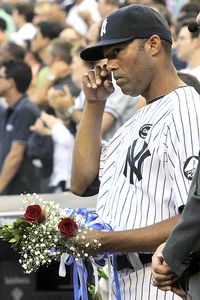
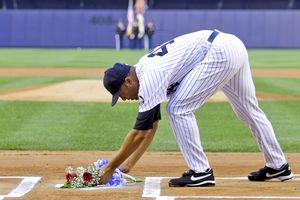
When the ovation died down, Mariano Rivera jogged out to place two red roses wrapped in white and blue ribbon on home plate, a fitting way to honor the memory of Steinbrenner and Sheppard.

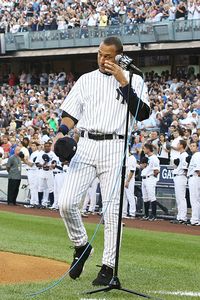
After Rivera laid the flowers at home plate, a recording of Sheppard's voice was played to direct fans' attention to behind home plate, where Derek Jeter spoke to honor the longtime owner and P.A. man.

"Simply put, Mr. George Steinbrenner and Mr. Bob Sheppard both left this organization in a much better place than when they first arrived," Jeter said in his address to the crowd. "They've set the example for all employees of the New York Yankees to strive to follow."

Jeter then asked the crowd to join him in a moment of silence, which was followed by a rendition of "Taps" played by Staff Sgt. Mikki Skinner, a bugler with the West Point Band.

The Yankees also placed a wreath in front of the Steinbrenner statue in the Gate 2 executive lobby and in front of Sheppard's plaque in Monument Park before the game.

Perhaps the most fitting tribute to Sheppard on Friday was the fact that Paul Olden, current Yankees public address announcer, was silenced for the night. There were no pregame lineups and no hitter announcements from Olden.
Outside of the stadium, the memorial to Steinbrenner at Gate 4 that began on Tuesday morning grew in size and scope. Fans placed candles, flowers, cards, newspaper clippings, empty beer cans and Yankees hats and jerseys on the ground to honor Steinbrenner and Sheppard.

Perhaps the most fitting tribute was a blue blazer and white turtleneck -- Steinbrenner's trademark look -- placed on the ground with a card in the front pocket that read: "Long live the spirit of the Boss."

"He deserves it," said Stewart Fellner, a season-ticket holder from Wantagh who soaked in the tribute before the game. "I wasn't going to come, but I said 'I have to go, I have to pay my respects.'"

The Yankees also wore memorial patches for Steinbrenner and Sheppard. Steinbrenner's was over the heart, right above the interlocking "NY," and Sheppard's was sewn onto the left sleeve.

"We'll be reminded every day by what's on our jerseys that the Boss is watching from above," Joe Girardi said.

Rivera Speaks in Ceremony to Sheppard and Boss

New York Yankees reliever Mariano Rivera said the past few days following George Steinbrenner's death have been difficult. The Yankees ace closer said he's been "missing" the only Boss he's known in his 20 years of pro ball.

Mariano RiveraSo it was more than fitting that Rivera went out on Friday night and paid tribute to Steinbrenner in a way that would mean the most to the longtime Yankees owner -- he pitched a scoreless ninth to earn the win in the Bombers' walk-off 5-4 victory over the Tampa Bay Rays.

"The Boss would've been proud," Rivera said after getting through an eventful ninth to lower his ERA to 1.02.

About three hours before he took the mound, Rivera placed two roses wrapped in white and blue ribbon on home plate during a stirring pregame ceremony to honor Steinbrenner and longtime Yankee PA announcer Bob Sheppard, who died Sunday.

Rivera said he was emotional during the pregame ceremony. But in the ninth inning, he found it easy to focus on baseball. After all, it's what Steinbrenner would've wanted him to do.

"He would say that," said Rivera, who was pitching for the first time in eight days. "We had a job to do so let's go get it done."

Rivera entered a 4-4 tie game in the ninth. He surprisingly picked off B.J. Upton at first after the Rays' leadoff hitter reached on an infield single. The pickoff was Rivera's first since 2003 and the fifth of his career.

Rivera thought Upton never should have reached base, but Alex Rodriguez couldn't make a play on a sharp liner by Upton because he was trying to avoid the barrell of Upton's bat, which was flying toward his head. Rivera (3-1) then got Carl Crawford to fly out and struck out Evan Longoria on a 2-2 cutter to end the ninth.

Rivera, 40, was one of the first Yankees to jump out of the dugout to celebrate Nick Swisher's walkoff single that scored Curtis Granderson in the bottom of the inning.

"In a sense, Mo opened it up and he closed it out," Yankees manager Joe Girardi said.

Before the game, Rivera shared his most-cherished Steinbrenner memory, which dates back to the 2000 World Series against the New York Mets.

Rivera said he made a bet with The Boss before the Subway Series: If the Yankees beat the Mets, Steinbrenner would fly Rivera on his private plane to the destination of the reliever's choice. If the Yankees lost, Rivera would take Steinbrenner out to dinner at the restaurant of the owner's choice.

"And we won, thank God," Rivera said. "The second day after we won, he called and made sure that I was ready for my trip with my family."

Rivera also recalled Steinbrenner -- who died on Tuesday morning after suffering a heart attack at his home in Tampa, Fla. -- as a mentor and motivator.

"The character that he has and the willing heart that he has, that always made him special," Rivera said. "[I'm] definitely missing him. ... For the first time, you know for sure he ain't gonna be here, period."

Rivera said he was away on vacation Tuesday morning when he first saw television news reports that Steinbrenner had died.

He said he "didn't want to believe it" at first, so he called Yankees traveling secretary Ben Tuliebitz to see if it was true.

After Tuliebitz confirmed the news, Rivera was shaken and somber.

"He sounded like a member of his family passed away," Tuliebitz recalled on Friday.

Rivera said the days following Steinbrenner's death were "hard"and added that he had "a lot of things going though my mind" prior to the game.

But Rivera cleared his head in the ninth inning on Friday and found the perfect way to pay tribute to Steinbrenner on Friday night -- with a win.

Jeter Address Crowd Before Friday Night's Game

Derek JeterNew York Yankees shortstop Derek Jeter might wear No. 2 on his jersey.

But in the late George Steinbrenner's eyes, Jeter was clearly the favorite.

Maybe that's why Jeter was so emotional about Friday night's pregame ceremony after the Yankees' dramatic, 5-4, come-from-behind win over the Tampa Bay Rays at Yankee Stadium.

"I thought it was wonderful. It's an honor to be a part of it," Jeter said of the pregame ceremony. "I can see some people, some fans were very emotional -- rightfully so."

Jeter's being modest couldn't hide the fact that he had a special relationship with Steinbrenner.

Sure, Steinbrenner -- who died Tuesday of a massive heart attack at 80 years old -- was attached to many players and managers during his tenure as owner. He had a love/hate relationship with Billy Martin. Steinbrenner adored Reggie Jackson, even though they had many ups and downs. "The Boss" was crazy about Lou Piniella, as both a player and a manager.

Still, you got the sense the only thing Steinbrenner liked more than winning World Series titles was Jeter. And it showed during the memorial.

In the video tribute to Steinbrenner, Jeter's was the first player's voice you heard. He also was the first player you saw. The first picture you saw of Steinbrenner with a player, it was, of course, Jeter.

That wasn't by happenstance. Anybody around that organization the past 16 years knows about the special relationship between Steinbrenner and Jeter.

That's why it was so fitting that Jeter spoke to the huge crowd on a night to remember. He had kind words for both Steinbrenner, who bought the team from CBS in 1973 for $8.7 million, and longtime public address announcer Bob Sheppard. Sheppard died Sunday at age 99.

"We're gathered here tonight to honor two men who were both shining stars in the Yankee universe,'' Jeter said. "Both men, Mr. George Steinbrenner, Mr. Bob Sheppard, cared deeply about their responsibilities to this organization and to our fans.

"And for that, they will forever be remembered in baseball history and in our hearts.''

For Steinbrenner, Jeter represented all the things he tried to instill in this franchise when he took it over and tried to re-establish the Yankees as the top of the heap in Baseball America. It was Jeter's drive, determination and class that attracted Steinbrenner.

Jeter found out about Steinbrenner's death when he woke up Tuesday in Anaheim, Calif. He said his phone was filled with messages offering condolences for his loss. A reporter asked Jeter whether he first thought it was a family member. Without hesitation, Jeter said, "Well, it was a family member. It isn't an immediate family member, but it is a family member.''

Since Steinbrenner's death, Jeter has been interviewed many times. A couple of things stand out in his comments, especially when Jeter says he and Steinbrenner were friends.

It sounds so real, honest. It's not Jeter trying to be nice or paint the controversial Steinbrenner in a different light to make him look better to the masses.

Jeter, of course, respected the owner/player relationship. He never lost sight of the fact that no matter what, Steinbrenner was the man who paid him to work for him.

Still, they spent time together. They ate together and took jabs at each other when it came to college football. Jeter is from Michigan, and Steinbrenner was a die-hard Ohio State fan.


The event that probably brought the two really close was when Steinbrenner publicly criticized Jeter for hanging out and enjoying the New York nightlife a bit too much. It was the first time anyone had said anything negative about Jeter.

Some would have been put off by it and repelled by Steinbrenner. It could have turned Jeter sour on The Boss.' Instead, Jeter not only cleaned up his act, but probably wound up having even more respect for Steinbrenner.

The two wound up having fun with it later on in a Visa commercial. The last scene had Jeter and Steinbrenner in a nightclub, part of the same conga line. It was a funny spot.

Their strong relationship, however, was clearly real.

Sheppard Laid to Rest on Long Island

The long and distinguished life of Bob Sheppard was celebrated Thursday morning at a funeral Mass in his hometown on Long Island.

Several hundred family, friends and fans gathered at St. Christopher's Church to honor and remember the longtime New York Yankees and New York Giants public address announcer, who died Sunday at the age of 99.

Yankees general manager Brian Cashman, Giants president and CEO John Mara and former St. John's men's basketball coach Lou Carnesecca were among those invited to speak about Sheppard.

Former New York City mayor Rudolph Giuliani was also in attendance, and famed Irish tenor Ronan Tynan sang two hymns during the service.

Sheppard was nicknamed "The Voice of God" for his deep and distinctive voice, and for his precise pronunciation of words and names. He was also highly regarded personally for his humility and grace.

He worked for the Giants from 1956 to 2005 before retiring from football, and for the Yankees from 1951 to 2007, until he became ill with a bronchial infection. He also taught speech at St. John's University.

"In an era in which too many public address announcers act like cheerleaders ... Bob Sheppard stood out as the most distinguished and dignified voice in all of sports," Mara said. "In one man's humble opinion, Bob deserves a place in both Cooperstown, N.Y., and in Canton, Ohio."

"He came to the stadium -- Yankee Stadium -- for 57 years, each and every day, focused on two things," Cashman said. "Doing his job to the absolute best of his ability, and treating everyone -- from George Steinbrenner to the press box attendant -- with warmth and kindness."

Sheppard's wife, Mary, was at the church, along with Sheppard's four children: sons Paul and Chris, and daughters Barbara and Mary. Paul also spoke during the service.

"Although Dad will most be remembered for being a Yankee and Giant announcer, his priorities were tied for first: the Catholic Church, and family," Paul said. "Second [was] teaching. And third, announcing."

Sheppard was a devout Catholic, who attended early-morning Mass daily for the past 50 years. He also served as a lector at St. Christopher's, and at Sunday Masses held at Yankee Stadium.


One fan -- Salvatore Candiano -- held a sign above his head. It read, simply:

"LONG LIVE THE VOICE."

As it turns out, Candiano is a huge Mets fan. But he lives in Baldwin, and was a neighbor of Sheppard's.

"Mr. Sheppard transcended team rivalries," Candiano said. "Bob Sheppard was a legend. I just wanted to say my piece."

When the hearse carrying Sheppard's coffin finally pulled away from St. Christopher's, the many people still mingling outside the church broke into a solemn yet stirring round of applause.

A very fitting end to an extremely well-lived life.

"I have a very strong feeling that the Lord has already recruited Dad," Sheppard's son Paul said in his closing remarks. "And if you and I are fortunate someday to reach the heavenly gates, we'll probably hear, 'Good afternoon, ladies and gentleman. Welcome to heaven.'"

Tuesday, July 13, 2010

George Steinbrenner Passes Away

George Steinbrenner, whose big wallet and win-at-all-cost attitude whipped the New York Yankees into a billion-dollar sports empire, died Tuesday morning. He had just celebrated his 80th birthday July 4.


"George was 'The Boss,' make no mistake," Hall of Famer Yogi Berra said. "He built the Yankees into champions, and that's something nobody can ever deny. He was a very generous, caring, passionate man. George and I had our differences, but who didn't? We became great friends over the last decade and I will miss him very much."

In 37-plus seasons as owner, Steinbrenner led the Yankees to seven World Series championships, 11 American League pennants and 16 AL East titles.

"He was and always will be as much of a New York Yankee as Babe Ruth, Lou Gehrig, Joe DiMaggio, Mickey Mantle, Yogi Berra, Whitey Ford and all of the other Yankee legends," baseball commissioner Bud Selig said. "Although we would have disagreements over the years, they never interfered with our friendship and commitment to each other. Our friendship was built on loyalty and trust and it never wavered."

New York was 11 years removed from its last championship when he headed a group that bought the team from CBS Inc. on Jan. 3, 1973, for about $10 million.

He revolutionized the franchise -- and sports -- by starting his own television network and ballpark food company. Forbes now values the Yankees at $1.6 billion, trailing only Manchester United ($1.8 billion) and the Dallas Cowboys ($1.65 billion).

"He was an incredible and charitable man," his family said in a statement. "He was a visionary and a giant in the world of sports. He took a great but struggling franchise and turned it into a champion again."

The Steinbrenner family said that funeral arrangements will be private; however, details about an additional public service will be announced at a later date.

Flags were lowered to half-staff at New York's City Hall and a marquee outside the $1.5 billion Yankee Stadium -- "the house that George built" -- honored "George M. Steinbrenner III, 1930-2010."

He ruled with obsessive dedication to detail, overseeing everything from trades to the air blowers that kept his ballparks spotless. He admittedly was overbearing, screaming at all from commissioners to managers to secretaries.

His reign was interrupted for suspensions, including a 15-month ban in 1974 after his guilty plea to conspiring to make illegal contributions to President Richard Nixon's re-election campaign. He was pardoned 15 years later by President Ronald Reagan.

Steinbrenner's death on the day of the All-Star Game was the second in three days to rock the Yankees. Bob Sheppard, the team's revered public address announcer from 1951 to 2007, died Sunday at 99.

The Yankees said they will wear patches on their uniforms honoring the memory of Steinbrenner and Sheppard. The Steinbrenner patch will be worn above the interlocking NY on the pinstriped home uniform and above the "York" on the road grays. The patch commemorating Sheppard will be worn on the left sleeve of the home and away uniforms.

A video tribute was shown at the All-Star Game and players bowed their heads during a moment of silence before the national anthem was played at Angel Stadium. The Yankees wore black armbands, and the U.S., Canadian and California flags were lowered to half-staff.

"He was truly the most influential and innovative owner in all of sports," former New York Mayor Rudy Giuliani said. "He made the Yankees a source of great pride in being a New Yorker."

The son of a shipping magnate, Steinbrenner lived up to his billing as "The Boss," a nickname he earned and clearly enjoyed as he ruled with an iron fist. While he lived in Tampa he was a staple on the front pages of New York newspapers.

Steinbrenner's mansion, on a leafy street in an older neighborhood of south Tampa, was quiet Tuesday. Private security guards milled around on the empty circular driveway inside the gates. A police officer turned away reporters along the narrow street. News vehicles lined the other side of the street.

"The passing of George Steinbrenner marks the end of an era in New York City baseball history," rival Mets owners Fred and Jeff Wilpon and Saul Katz said. "George was a larger-than-life figure and a force in the industry."

Steinbrenner was known for feuds, clashing with Berra and hiring manager Billy Martin five times while repeatedly fighting with him. But as his health declined, Steinbrenner let sons Hal and Hank run more of the family business.

Steinbrenner was in fragile health for years, resulting in fewer public appearances and pronouncements. Yet dressed in his trademark navy blue blazer and white turtleneck, he was the model of success.

"Few people have had a bigger impact on New York over the past four decades than George Steinbrenner," Mayor Michael Bloomberg said. "George had a deep love for New York, and his steely determination to succeed combined with his deep respect and appreciation for talent and hard work made him a quintessential New Yorker."

He appeared at the new Yankee Stadium just four times: the 2009 opener, the first two games of last year's World Series and this year's home opener, when captain Derek Jeter and manager Joe Girardi went to his suite and personally delivered his seventh World Series ring.

"He was very emotional," said Hal Steinbrenner, his father's successor as managing general partner.
Jeter said Tuesday that Opening Day was the last time he saw George Steinbrenner.

"I think he's a father figure to everyone that was in our organization in the past or present, because he really took care of his players," Jeter said.

"I remember my first, second year, I was on third base and got doubled off on a line drive in the infield and we won the game. After the game he was yelling at me for, 'Don't ever get doubled off again. We won the game, but he expected perfection, and that rubbed off. And whether it was the players, the front office, the people working at the stadium, didn't make a difference. He expected perfection."

Until the end, Steinbrenner demanded championships. He barbed Joe Torre during the 2007 AL playoffs, then let the popular manager leave after another loss in the opening round. The team responded last year by winning another title.

"I will always remember George Steinbrenner as a passionate man, a tough boss, a true visionary, a great humanitarian, and a dear friend," Torre said. "It's only fitting that he went out as a world champ."

Steinbrenner had fainted at a memorial service for NFL great Otto Graham in 2003, appeared weak in 2006 at the groundbreaking for the new stadium and later became ill while watching his granddaughter in a college play. At this past spring training, he used a wheelchair and needed aides to hold him during the national anthem.

Still, the former Big Ten football coach took umbrage when others questioned his fitness.

"I am not ill. I work out daily," Steinbrenner said in 2006. "I'd like to see people who are saying that to come down here and do the workout that I do."

When Steinbrenner bought the team, he famously promised a hands-off operation.

"We're not going to pretend we're something we aren't," he said. "I'll stick to building ships."

It hardly turned out that way. Consider his dealings with Dave Winfield. Steinbrenner paid to dig up dirt on the outfielder and derided the future Hall of Famer as "Mr. May" in 1985 after poor performances.

"There is nothing quite so limited as being a limited partner of George Steinbrenner's," one of them, John McMullen, said later.

Still, Steinbrenner could poke fun at himself. He hosted "Saturday Night Live," clowned with Martin in a commercial and chuckled at his impersonation on "Seinfeld." He gave millions to charity, often with one stipulation, that no one know who made the donation.

Steinbrenner spent freely, shelling out huge amounts for Jeter, Reggie Jackson, Alex Rodriguez, Torre and others in hopes of yet another title. And the team's value increased more than 100-fold from the $8.7 million net price his group paid in 1973.

"Winning is the most important thing in my life, after breathing," Steinbrenner was fond of saying. "Breathing first, winning next."

All along, he envisioned himself as a true Yankee Doodle Dandy. It was fitting: George Michael Steinbrenner III was born on the Fourth of July, in 1930.

He joined the likes of Al Davis, Charlie O. Finley, Bill Veeck, George Halas, Jack Kent Cooke and Jerry Jones as the most recognized team owners in history. But Steinbrenner's sporting interests extended beyond baseball.

He was an assistant football coach at Northwestern and Purdue in the 1950s and was part of the group that bought the Cleveland Pipers of the American Basketball League in the 1960s.

He was a vice president of the U.S. Olympic Committee from 1989 to '96 and entered six horses in the Kentucky Derby, failing to win with Steve's Friend (1977), Eternal Prince (1985), Diligence (1996), Concerto (1997), Blue Burner (2002) and the 2005 favorite, Bellamy Road.

"His influence on the U.S. Olympic Movement, his devotion to sport and the pursuit of excellence will forever be remembered," the USOC said in a statement.

To many, though, the Yankees and Steinbrenner were synonymous. His fans applauded his win-at-all-costs style. His detractors blamed him for spiraling salaries and wrecking baseball's competitive balance.

Steinbrenner never managed a game, but he controlled everything else. When he thought the club's parking lot was too crowded, Steinbrenner stood on the pavement -- albeit behind a van, out of sight -- and had a guard personally check every driver's credential.

Steinbrenner made no apologies for his bombast, even when it cost him. He served two long suspensions: He was banned for 2½ years for paying self-described gambler Howie Spira to dig up negative information on Winfield, and for 15 months following a guilty plea for his conduct during the Watergate era.

"I haven't always done a good job, and I haven't always been successful," Steinbrenner said in 2005. "But I know that I have tried."

Steinbrenner negotiated a landmark $486 million, 12-year cable television contract with the Madison Square Garden Network in 1988 and launched the Yankees' own YES Network for the 2002 season.

The Yankees later became the first team with a $200 million payroll, provoking anger and envy among other owners. After the 1982 season, Baltimore owner Edward Bennett Williams said Steinbrenner hoarded outfielders "like nuclear weapons."

He also changed managers nearly two dozen times and got rid of more than a dozen general managers. When a Yankees public relations man went home to Ohio for the Christmas holiday, then returned in a hurry for a news conference to announce David Cone's re-signing, Steinbrenner fired him.

After Steinbrenner dismissed Berra as manager 16 games into the 1985 season, the Hall of Famer vowed he wouldn't go to back to Yankee Stadium for a game until Steinbrenner apologized.

One night in 1982, reliever Goose Gossage let loose and called Steinbrenner "the fat man." And in 1978, Martin said of Jackson and Steinbrenner: "The two of them deserve each other -- one's a born liar, the other's convicted."

There was no denying the results, however.

When Steinbrenner bought the Yankees, they had gone eight seasons without finishing in first place, their longest drought since Babe Ruth & Co. won the team's first pennant in 1921.

"George has been a very charismatic, controversial owner," Selig said in 2005. " But look, he did what he set out to do -- he restored the New York Yankees franchise."

On Tuesday, Selig fondly remembered the owner he knew for nearly four decades and considered a close friend even though there were usually on "opposite sides of the fence."

Selig said they traditionally resolved a couple of their lesser disputes with "gentlemanly wagers."

When their favorite college football teams matched up, Steinbrenner took Ohio State and Selig backed Wisconsin. In the NFL, Steinbrenner sided with Tampa Bay and Selig went with Green Bay.

"Nobody loved his team more than he did," he said.

"I'm sorry this day happened."

Former AL president Gene Budig sometimes was on the wrong end of Steinbrenner's barbs. After he left office, Budig maintained a friendship with him and even promoted Steinbrenner for the Hall of Fame.

Steinbrenner liked to quote military figures and saw games as an extension of war. No surprise that in the tunnel leading from the Yankees' clubhouse to the field, he had a sign posted with a saying from Gen. Douglas MacArthur: "There is no substitute for victory."

Steinbrenner also had a soft side. He sometimes read about high school athletes who had been injured and sent them money to go to college. He paid for the medical school expenses of Ron Karnaugh after the swimmer's father died during the opening ceremony at the 1992 Barcelona Olympics.

Steinbrenner kept older friends from his football days on the payroll, had a way of rehiring those he had once fired and liked to give second chances to those who had fallen from favor, such as Darryl Strawberry and Dwight Gooden.

"I'm really 95 percent Mr. Rogers," Steinbrenner said as he approached his 75th birthday, "and only 5 percent Oscar the Grouch."

White House press secretary Robert Gibbs said Steinbrenner touched the lives of people across the country through his work with various organizations and charities over a long and storied career. And that's on top of the seven World Series titles he brought home to New York.

While Steinbrenner grew up in the Cleveland area as a Yankees fan, his first passion was football. He fondly recalled watching the Browns on cold winter days and many believe the NFL's must-win-today mentality shaped how he approached all sports.

Steinbrenner was raised in a strict, no-nonsense household headed by his father, Henry. The oldest of three children, Steinbrenner attended Culver Military Academy in Indiana. At Williams College, he was a track man and specialized in hurdles.

After that, he enlisted in the Air Force. Steinbrenner always was partial to the military and at Yankee Stadium, men and women in uniform were admitted free.

Following his discharge, he enrolled at Ohio State, pursuing a master's degree in physical education. It was his intention to go into coaching, but after working at a high school in Columbus and at Purdue and Northwestern, he turned to the business world. Steinbrenner married Elizabeth Joan Zieg in 1956 and they had four children.

In 1963, Steinbrenner purchased Kinsman Transit Co., a fleet of lake ore carriers, from his family and built a thriving company. Four years later, Steinbrenner and associates took over American Shipbuilding and revitalized the company.

It was in Cleveland that Steinbrenner met veteran baseball executive Gabe Paul and became involved with the group that bought the Yankees. With 13 partners, Steinbrenner purchased the team from CBS Inc.

"When you're a shipbuilder, nobody pays any attention to you," he said. "But when you own the New York Yankees ... they do, and I love it."

With that, the Bronx Zoo days began. It was while he was under suspension that the Yankees ushered in baseball's new free-agent era by signing Catfish Hunter to a $3.75 million contract. Even though he was officially barred from participating in the daily operation of the team, no one believed Steinbrenner was not involved in that deal.

For the first five years of the free agency, Steinbrenner signed 10 players at an approximate cost of $38 million. Steinbrenner's $18.2 million, 10-year deal with Winfield was the richest free-agent contract in history.

Winfield, now an ESPN baseball analyst, said Tuesday that Steinbrenner was all about winning.

"He didn't want to lose at all. A [player] had to come in there and want to win, know how to win, and lay it all on the line. Otherwise, they were in trouble ... they'll have to look at him as one of the top owners in sports."

During those days, Yankee Stadium underwent a $100 million face-lift and reopened in 1976. That year, the Yankees won the AL pennant, but got swept in the World Series by Cincinnati's Big Red Machine. The Yankees surged back to win the World Series in 1977 and 1978 and the AL pennant in 1981.

While the Yankees' roster continually changed, so did the team's front office. However, the one constant for most of Steinbrenner's time, was winning. Asked his formula for success, he said: "Work as hard as you ask others to. Strive for what you believe is right, no matter the odds. Learn that mistakes can be the best teacher."

In addition to his sons, Steinbrenner is survived by his wife, Joan, daughters Jennifer and Jessica and 13 grandchildren.
Bob Sheppard Passes Away

Bob SheppardThe Voice of God is now, and some would say fittingly, headed up there.

Sheppard, whose elegant introductions of stars from Joe DiMaggio to Derek Jeter at Yankee Stadium for more than a half century earned him the nickname "The Voice of God," died Sunday. He was 99.

For more than a half-century, Bob Sheppard did what baseball teams demand of their pitchers: He repeated his delivery, again and again and again, day in, day out, the same way every single time.

And during that time, he did what all businesses, even professional baseball teams, used to demand of their employees: that they represent their employers with the utmost class, dignity and professionalism.

We live in a different world now -- a world in which louder, gaudier and more vulgar are mistaken for better, a world in which arguments are won by he who shouts longest, a world in which the technological ability to do 15 things poorly is valued above the talent to do one thing well.

Sheppard came from a different world, a world in which the sound track of baseball was the smack of horsehide against leather and the crack of baseball against wood.

And, oh yes, the occasional sound of the voice of the public-address announcer informing you of who was coming to bat.

Throughout his lifetime, Sheppard did many things well and one thing impeccably.

That one thing -- the clear, concise, informative and authoritative act of announcing who would be the next man to come to bat -- is the reason his memory will live on long after his tape-recorded introduction of Derek Jeter is played for the last time.

Sheppard's death was not exactly unexpected, considering his mellifluous tones -- there really is no other word to describe them -- had not been heard at a Yankees game in three years and never (except for that recorded introduction that Jeter has insisted be played before every one of his home at-bats) at the new stadium.

Jeter said Sunday he'll continue to use Sheppard's voice as his introduction for each at-bat.

"Players changed year in and year out, he was the one constant," Jeter said. "Every time you heard it, you got chills."

In a special tribute to Sheppard, Major League Baseball will have Sheppard's recorded voice introduce Jeter during Tuesday's All-Star Game.

When the team moved into new Yankee Stadium last year, it honored him by naming the media dining room after him.

In a prepared statement, Yankees principal owner George M. Steinbrenner called Sheppard "a good friend and fine man whose voice set the gold standard for America's sports announcers.

"For over a half century, fans were thrilled to hear his unforgettable voice and players were thrilled to hear his majestic enunciation of their names," Steinbrenner said. "Bob Sheppard was a great member of the Yankees family and his death leaves a lasting silence. My thoughts and prayers are with his wife, Mary, and their family."

And although this is no longer Sheppard's world -- this world of blaring walk-up music for each batter, ballparks papered in advertisements so that they look like shopping malls, and PA announcers who sound more like circus ringmasters -- the world we have now is made poorer by his passing.

Because from 1951, when he announced his first Yankees batter -- "Now batting for the Yankees, the left fielder, No. 27, Jackie Jensen" -- to 2007, the precise enunciation of Bob Sheppard was the one true link from the Yankees of Jeter not only to the Yankees of DiMaggio but also to an era in which the game was the thing, the one true reason for being at the ballpark.

Sheppard became as much as a fixture in the Bronx ballpark as the familiar white stadium facade or Monument Park, tucked behind the blue outfield wall.

On May 7, 2000, after 50 years and two weeks on the job, the team honored him with "Bob Sheppard Day" and put a plaque in his honor in Monument Park. Fans gave Sheppard a standing ovation, and legendary news anchor Walter Cronkite read the inscription. Berra, Reggie Jackson and Don Larsen were among those who stood on the field during the ceremonies.

"The voice of Yankee Stadium," read the plaque. "For half a century, he has welcomed generations of fans with his trademark greeting, 'Ladies and gentlemen, welcome to Yankee Stadium."

Today, people go to the ballpark for many reasons, and sometimes it seems as if the least of them is to actually watch the ballgame. They go to see and be seen, to schmooze with clients, to make cell phone calls and wave from their obscenely expensive seats in full camera range behind home plate, to cruise the food courts and the memorabilia shops, and occasionally to glance at what is happening on the field.

These days, the game often seems like either just a backdrop or a lure to get people into the ballpark so that vendors can sell them things.

When Sheppard started announcing Yankees games, the action on the diamond was all the sensory assault necessary to make what is now known as "the stadium experience" a worthwhile pursuit.
And so anonymous was the PA announcer that Sheppard did not even know the name of the man he replaced. (It is believed to have been Red Patterson.)

His job, like the job of the television play-by-play announcer, was to provide the viewer with the basics and then get out of the way and let the game speak for itself.

This was before the days of the grotesquery of NBA PA announcers -- each of whom has a customized hometown call -- and before the advent of TV announcers who think they are bigger than the event they are calling, and before some genius decided that a few moments of silence during a baseball game -- such as between pitches -- was some kind of dead zone that needed to be filled.

Those of us old enough to remember when a ballpark was somewhere you went to actually watch the game and engage in friendly banter with those around miss those days terribly. Those of you too young to know anything but the audio/visual attack that is a day at the ballpark today have no idea what you are missing.

Sheppard was the last link to the old Yankee Stadium -- the stadium of Ruth and Gehrig -- and to old baseball, the baseball of Murderer's Row and the Gashouse Gang and Dem Bums of Brooklyn.

His wasn't a loud voice or a booming voice. It didn't grab you by the lapels and demand you listen. But in its firm, precise way, it was a commanding voice, one to which you just instinctively knew that attention must be paid.

There was a cadence to it, and a discipline, an unwavering pattern. The first time through the order, he gave you the player's position, his number, his name and his number. After that, just the position and the name.

There was no editorializing, no rooting, no indication from the announcement alone whether the player was a Yankee or a Seattle Mariner, or whether the player was a star or a scrub. He announced Jeter with the same panache that he announced, say, Eric Hinske.

This is not to imply that Sheppard was a saint, or that his motives were always pristine, or that he was a last holdout in a world rapidly spinning toward terminal crassness.


(A great story recounted by Bill Madden in his recent biography, "Steinbrenner: The Last Lion of Baseball," has Sheppard refusing to interrupt the ritual of his pregame dinner to deliver an amplified apology to "our Canadian friends" at the stadium after a singer mangled "O Canada.")

And he quickly came to appreciate the Yankees' use of Frank Sinatra's recording of "New York, New York" as a useful way for him to beat a hasty retreat to his car for the drive home to Baldwin, N.Y., immediately after the final out of a game.

Sheppard was famously secretive about his age and a bit vain about his appearance. Former Yankees PR man Rick Cerrone, who remained a lifelong friend of Sheppard's, remembers being shocked at how old Sheppard was on their first meeting in 1977, because the picture in the Yankees' media guide had not been changed since 1959. But, about his dedication to his craft, there could be no doubt.

And in a profession marked by its anonymity -- quick, tell me the name of the PA announcer at Citi Field, for instance? -- Sheppard's unique delivery, as precise and recognizable as Tom Seaver's windup, was valued equally by players and fans.

In his later years, Sheppard often would sit in the Yankees' dugout during batting practice, and players would creep over, timidly, and ask to meet "Mr. Sheppard." When he joined the Yankees, Alex Rodriguez asked Cerrone whether he could help him get an autograph.

Once, in 2001, Sheppard came down with laryngitis and needed relief in the middle of a game. Cerrone, a former radio announcer who had "done Sheppard" while serving as the football and wrestling PA announcer at Yorktown High School in Yorktown, N.Y., was forced to fill in. He did so, in what he thought was a pretty passable imitation.

After the game, he was accosted in the Yankees' clubhouse by Don Mattingly. "Who was that doing the PA announcements today?" Mattingly asked. "It wasn't Sheppard."

It reminded Cerrone of a time nearly 30 years earlier when the Yankees announced their affiliation with a Triple-A team in Nashville -- and to commemorate the occasion, Sheppard turned over the Yankee Stadium microphone to the minor league team's PA man for what was supposed to be the next three innings.

After the first batter, Billy Martin -- then the Yankees' manager -- stuck his head out of the dugout and stared up at the press box. After the second batter, he used the dugout phone to ask what in the hell was going on up there.

And for the third batter, Bob Sheppard was back to doing what he did for 56 years. And he did so impeccably -- repeating his delivery, again and again, day in and day out, the same way every single time. Displaying the excellence of consistency and precision, and demonstrating the genius of doing just one thing as well as it has ever been done.

In addition to his wife, Sheppard is survived by sons Paul and Christopher, daughters Barbara and Mary, four grandchildren and at least nine great-grandchildren.

A wake will be held Tuesday and Wednesday, with the funeral Thursday in Baldwin.